Parabola 12 SupportFinding the Diameter Direction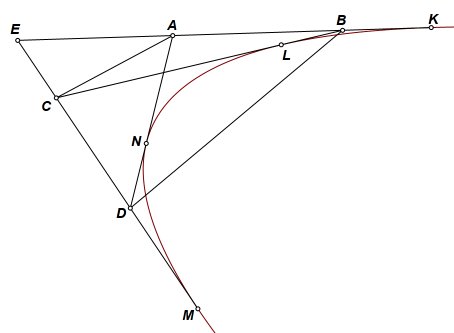 Let the four sides of quadrilateral (anti‑quadrilateral in this example) ABCD be tangent to a parabola, with AB, BC, CD, and DA touching at K, L, M, and N, respectively. Let AB and CD intersect at E. In the construction problem being considered here, only the quadrilateral vertices are given, no points of tangency. Taking the tangent lines three at a time, Conica (III, 41) renders these proportions:  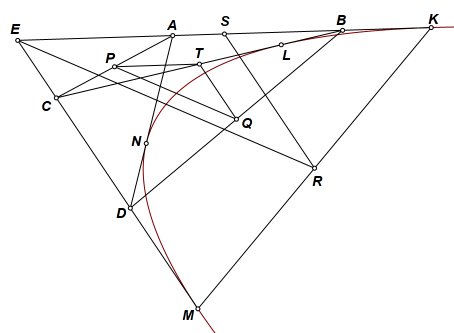 The first order of business will be to establish the direction of the diameters of the parabola. Draw AC with midpoint P, BD with midpoint Q, and KM with midpoint R. Let S be the midpoint of KE, and T the midpoint of BC. By Conica (II, 29), ER is a diameter, but remember, tangent points K and M would not have been given, so R could not yet be constructed. As a result of the proportions above, KE and EM are divided proportionally: 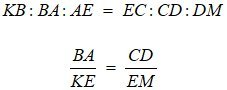 Line segments TP and TQ bisect sides of triangles BAC and CDB. 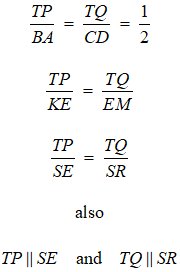 Similar triangles PTQ and ESR have two corresponding pairs of sides parallel and proportional, so the third pair, PQ and ER, must also be parallel. Since ER is a diameter, PQ must also be a diameter, and that line can be constructed from the given conditions. The given quadrilateral was ABCD, so AC and BD may be called the diagonals, and PQ is the line joining the midpoints of the diagonals. That diameter will be useful in the following section. 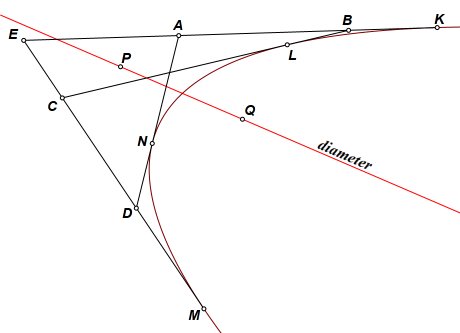 Constructing a Point of Tangency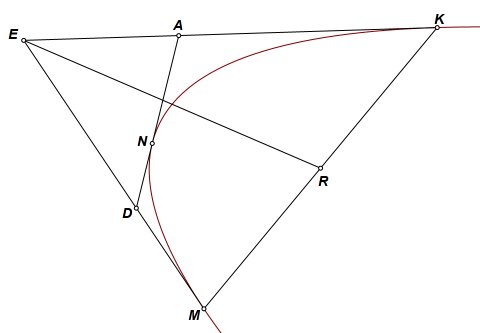 Only three tangent lines are required for construction of a point of tangency, so line BC has been hidden, leaving all sides of triangle AED tangent to the parabola. 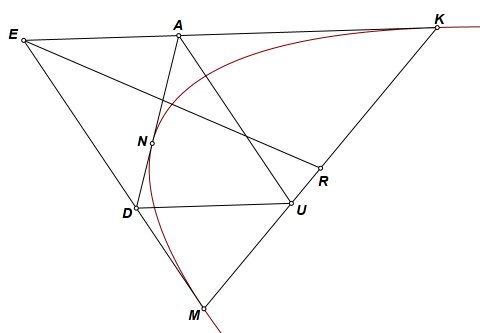 Points A and D were given, and E can be constructed. Complete parallelogram AEDU. Both of these new lines, AU and DU, must cut KM in the same ratio, so U falls on KM. 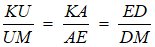 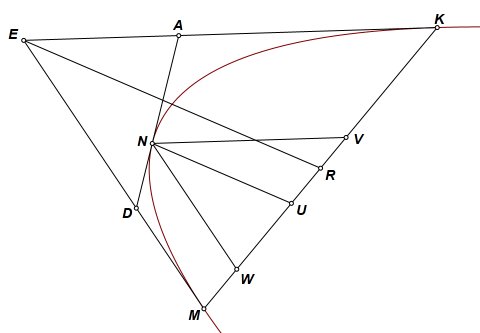 Construct points V and W on KM such that NV || EK and NW || EM. Join NU. Certain proportions result from the parallel lines: 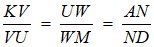 And from that it follows that U is the midpoint of VW: 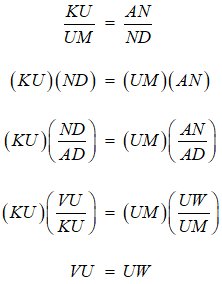 In triangles WNV and MEK, sides WV and MK are collinear, and the other two pairs of corresponding sides are parallel, so the triangles are similar. Also, their corresponding medians, NU and ER are parallel. It follows, then, that NU is a diameter. 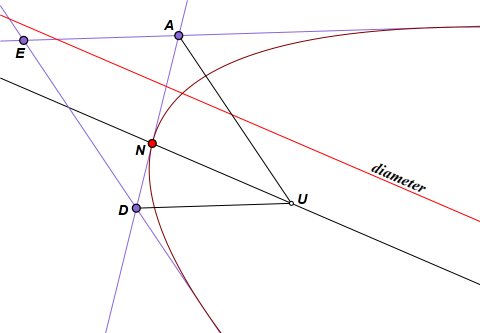 Now back up and use only the given points A, D, and E, and the diameter that was constructed above. Construct point U to complete parallelogram AEDU. Through U construct a line parallel to that diameter. This new diameter must intersect AD at N, the point of tangency. Back to Parabola Constructions Last update: May 8, 2026 ... Paul Kunkel whistling@whistleralley.com |